The Impostor by Javier Cercas & Frank Wynne
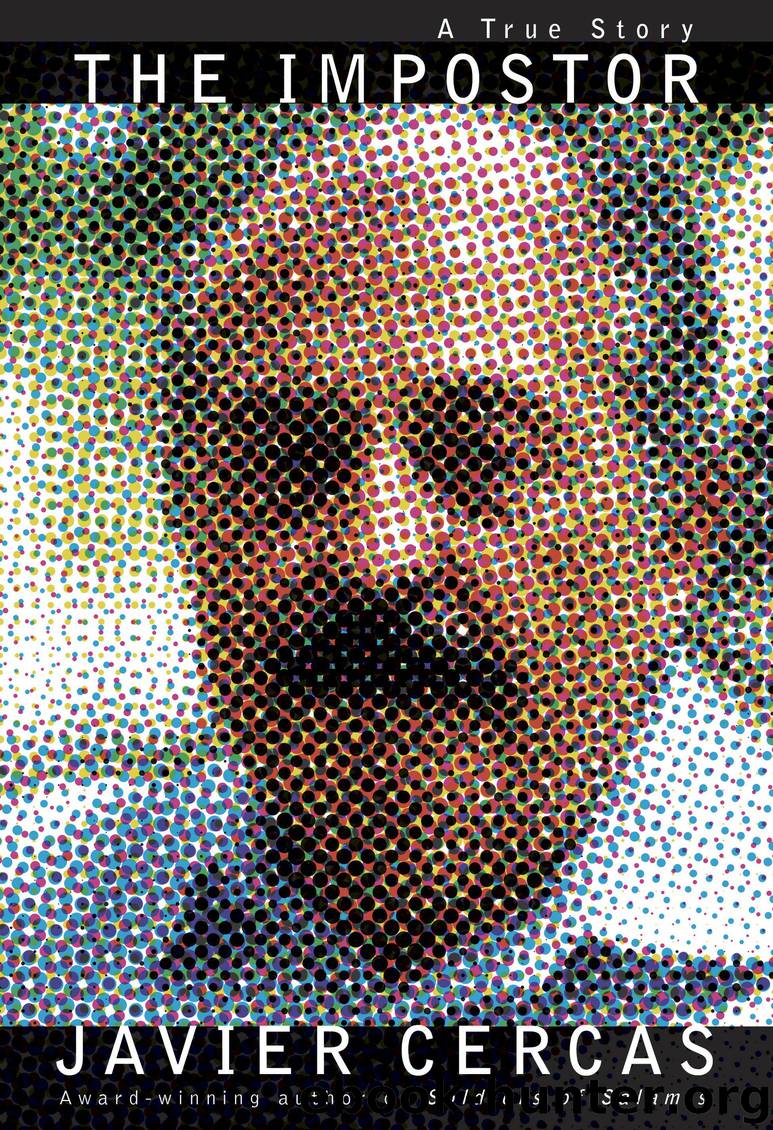
Author:Javier Cercas & Frank Wynne
Language: eng
Format: epub
Publisher: Knopf Doubleday Publishing Group
Published: 2018-08-27T16:00:00+00:00
* * *
—
The C.N.T.’s self-destruction didn’t come about because of the contradictions within it, but because of mistakes it made which made those same contradictions irreconcilable. The first, and perhaps the most important, was a miscalculation. In 1977, in the midst of the euphoria surrounding the rise of the union, the young anarcho-syndicalists who supported Marco proposed arranging a conference that would redefine the organisation, correct the anachronisms and the inefficiency of many of its approaches, adapting them to the modern world; it was a perfectly reasonable idea, especially considering that the last congress had taken place in 1936. But among the talking points, the young anarcho-syndicalists made the rash (or naive) mistake of including a review of the role played by the exiled leaders during the forty years of the Franco regime, and insisting that Federica Montseny personally write a report explaining what had happened during this period: Marco and his friends did not anticipate that the exiled veterans would take the proposal as they did: as a slap in the face, a threat or a snub by a bunch of ungrateful brats who, after the veterans had heroically held aloft the banner of freedom during the brutal years of the dictatorship, presumed to judge their behaviour and to settle scores. This tactical error unleashed a fury within the organisation.
But what eventually tipped the balance was the Scala affair. It happened on January 15, 1978, when Marco was still secretary general of the Catalonia chapter of the C.N.T. The union had organised a protest in Barcelona against the Moncloa Pact, an agreement proposed by the government of Adolfo Suárez and signed three months earlier by the main political parties, unions and business associations, eager to allay the social unrest in the country and to establish a process for regulating the economy during the transition from dictatorship to democracy; the protest was a success: some ten thousand people took part. But, towards midday, after Marco had brought the demonstration to a close on the plaza de España and the crowds had dispersed, four Molotov cocktails exploded in the Scala nightclub. Four workers died in the blaze. Although two victims were members of the C.N.T., suspicion for the attacks immediately focused on the union and its entourage, and also (at least within the union itself) on police infiltrators acting on orders of the government, who were seeking to discredit the only major union opposed to the process of the political transition because they considered it to be contrary to workers’ interests. Although the two theories were contradictory, both proved to be accurate. In December 1980, a court convicted six people with connections to the C.N.T. for the Scala bombing, but two years later, a police informant named Joaquín Gambín was also convicted of instigating and organising the attack. There can be no doubt that the government was interested in discrediting or even destroying the C.N.T., but it is impossible to rule out the idea that the most traditionalist, inflexible factions within
Download
This site does not store any files on its server. We only index and link to content provided by other sites. Please contact the content providers to delete copyright contents if any and email us, we'll remove relevant links or contents immediately.
| Africa | Americas |
| Arctic & Antarctica | Asia |
| Australia & Oceania | Europe |
| Middle East | Russia |
| United States | World |
| Ancient Civilizations | Military |
| Historical Study & Educational Resources |
Cecilia; Or, Memoirs of an Heiress — Volume 1 by Fanny Burney(32558)
Cecilia; Or, Memoirs of an Heiress — Volume 2 by Fanny Burney(31956)
Cecilia; Or, Memoirs of an Heiress — Volume 3 by Fanny Burney(31940)
The Secret History by Donna Tartt(19083)
Sapiens: A Brief History of Humankind by Yuval Noah Harari(14389)
Leonardo da Vinci by Walter Isaacson(13336)
The Radium Girls by Kate Moore(12026)
Sapiens by Yuval Noah Harari(5369)
How Democracies Die by Steven Levitsky & Daniel Ziblatt(5218)
The Wind in My Hair by Masih Alinejad(5095)
Homo Deus: A Brief History of Tomorrow by Yuval Noah Harari(4918)
Endurance: Shackleton's Incredible Voyage by Alfred Lansing(4780)
Man's Search for Meaning by Viktor Frankl(4604)
The Silk Roads by Peter Frankopan(4532)
Millionaire: The Philanderer, Gambler, and Duelist Who Invented Modern Finance by Janet Gleeson(4478)
The Rape of Nanking by Iris Chang(4211)
Joan of Arc by Mary Gordon(4109)
The Motorcycle Diaries by Ernesto Che Guevara(4098)
Stalin by Stephen Kotkin(3965)
